We are proud to be a little bit different here at Mill View Stables. Customers that come to Mill View Stables are ready for a change from the industry standard and restrictive practices that most livery yards adhere to. As I have kept my own horses at livery when I was young and then worked on professional yards throughout my career, I have seen livery yards from both a customer and employee view. Having this insight has allowed me to run a yard to high standard and meet the needs of all. We create the ideal living environment for horse whilst having an easy service that owners love to be part of. The whole yard and every aspect has our horses wellbeing at the forefront. Here are some of the main areas we have a different practices in:-
- Routine
- Turnout
- Atmosphere
- Tack
- Training and education
- Posture and strength of the horse
- Hoof care
Routine
As horses are heard animals, we keep the routine inclusive for all of the horses that live here. All the horses are fed, turned out, brought in and have late feedings at the same time. This means that all the horses are included, making them feel secure and stopping any stress related behaviours whilst waiting for care. No stressed horses are ignored at Mill View Stables. Being creatures of habit keeping the routine like this allows each horse to know what’s happening next and gives them safety and confidence. This helps to build calm and contented horses as they always know what to expect from their day.
Turnout
Did you know..? That wear patterns have been found (under dissection of domesticated horses) on the bones of the leg joints of horses that have been standing still for long periods of time. This means that horses that are stabled for 24/7 for 6 months of the year actually have wear patterns in their joints due to the lack of movement. Think how that might be affecting your horse’s movement and performance. Lack of turnout could be another key factor in the breakdown and burn out if many horses, not only for their physical health but for their mental health as well.
Turnout is an absolute must here at mill view stables, we turn out all year round and in all weathers. Horses are never cooped up in stables. As horses would naturally walk up to 25 miles a day it is important for every aspect of their health that they are allowed to have freedom of movement. Many systems in the horse’s body rely on movement to keep them working at top level, such as muscle and soft tissues systems such as the thoracic and sacropelvic slings, tendons and ligaments. The circulatory system, the recoil system, respiration, and digestive systems all rely on movement to be fully functional. Turnout is also hugely important for the horse’s mental health. It reduces stress, boredom and depression. It is of greater benefit to the horse when they are turned out in groups and herds. This allows them to present natural behaviours and group dynamics which all helps to sustain good mental health for your horse.
Atmosphere
Due to the efficiency of the staff the atmosphere on the yard is always calm and quiet making it an enjoyable place to be with your horse. The horses love the peaceful nature of the yard and settle almost immediately on arrival. Many stress or anxiety disorders such as separation anxiety, box walking, weaving, pawing and whinnying completely disappear as the horses find comfort and security. As the whole yard is treated like a herd, new horses with stress disorders gain comfort on a different level, that only other horses can provide. Human intervention can only go so far, horses need to be with other horses. Our set up allows the herd to act naturally, and all be together. Making each horse feel secure and alleviate stress.
At Mill View Stables it is just as important to us that our customers are as happy as their horses. The atmosphere on a yard hugely effects the happiness of the owner. Mill View Stables has tried to create a haven for owners to come and enjoy their horses, with out outside pressures or anxieties from other owners. We are not a “clicky” yard and welcome anyone who wants the best for their horse.
Tack
Over my career I have found that 99.99% of horses are suffering with ill fitting and painful tack. Not just saddles, bridles and bits. But girths, rollers, hard boots, training aids and gadgets. Tack is always encouraged to be checked at Mill View Stables. Not just the fit but the requirement of its use. You can walk into any tack shop or buy online any pieces of tack or equipment, and have very little or no idea of how it should be used or if it should be even used or how that effects the horse physically, biomechanically, emotionally or mentally. Sadly, as we want to make sure things are “working”, equipment and tack are made tighter or shorter, causing more and more restrictions. I often cringe when going into tack shops as to me it looks like implements of torture hanging on the walls and shelves. I always think how can this be legal, can owners not see how painful all this must be?
Can you imagine having a small child’s backpack put on you, which has a hard metal structure to hold the shape. It digs into your shoulders, pinches your arms as you move, and has buckles and clips sitting in your arm pits. Surely it would make you move and hold yourself in an awkward way, leaving you with intense pain whilst wearing the backpack, and leave lasting damage after it was removed. Also wearing this small uncomfortable backpack would affect your mood, making you irritable and grumpy. Now imagine wearing that backpack every day and having to exercise in it. It would be a horrible experience. This is what many horse owners unknowingly inflict on their horses. Changing painful or ill-fitting tack is the only quick fix to aid training there is in the horse world. As you can instantly stop inflicting pain and offer comfort instead just by changing tack. With many horses I work with this is all that’s needed. I am always amazed at how a change in tack can affect the horse, although I’m never surprised.
Here are a few quick tests you can do to give you an insight into how your tack feels for your horse.
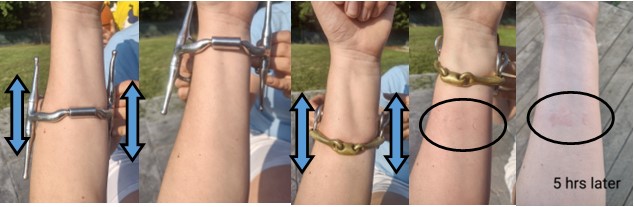
The bit test. You will need 2 people. Holding your forearm up, get a friend to hold your horse’s bit in the muscley part of your forearm. See the picture at the side. The muscle on the forearm is long and thin which is a good representation for the horse’s tongue. Then get your friend to move the bit rings as if they were the rider. Up and down, side to side, as if they were turning and stopping. I’m sure your friend will only put a fraction of the force onto your arm compared to what they would put down the reins. If the bit feels smooth and comfortable against your skin, it’s probably a good bit to put in your horse’s mouth. If the bit gives you pain by nipping, digging in or crushing, leaving skin indents, bruising and red marks, it’s probably not a good idea to use it on your horse. Many people I have tried this test with are shocked at the level of pain and damage that is inflicted on them after only seconds. Which is a sobering thought, as most horses are bitted from 30mins to over a 1hr. This is a very simple test that will allow you to check before buying or using a bit.
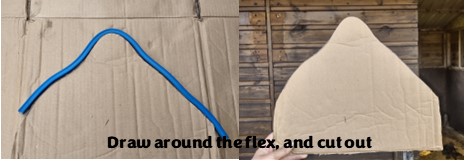
Saddle fit test. You will need a piece of wire that holds its shape such as a coat hanger or a flex measure. With your horse standing as comfortably square as possible, use the wire or flex to take an impression of the outline of the withers and shoulders where your saddle sits. See picture. This should leave you with a template of the width of your horse. Then place the template under your saddle, see picture. If your template can fit under your saddle, you know there is enough space for your horse to fit into it. If there is no room for your template to fit under your saddle, you know that there isn’t enough space for your horse to fit into.



Training and education
Training and education are so incredibly important to build a strong sustainable relationship with your horse. There is nothing more joyous than riding and working with a well-trained horse. It makes all aspects of horsey activities fun, safe and enjoyable, as the horse knows what is expected of it in each situation. No owner wants to be in that horrible place where they just can’t get their horse to do what they want it to do. This can be anything from loading, being hosed off, a ridden aim or walking calmly to the field.
We need to have clear communication with our horses in a way they can understand. We train both horse and owner to get back in harmony with each other. Allowing owners to see a holistic view of what their horses are communicating to them. As well as teaching clear techniques that enable them to communicate with their horse. Knowledge is shared freely by everyone here at Mill View Stables. As we want to help everyone reach their goals. Owners are encouraged to study any area of the horse world they are interested in, and there is a keen interest in CPD days, talks and courses that are undertaken.
We take a very calm and quiet approach to training, letting the horse’s natural attitude, stamina and ability set the pace. It is important to train horses at the correct workload as we believe this creates trust and confidence, making our horses happy and willing to learn. It is crucial that horses are not work to the point of exhaustion, fatiguing and overloading the structures of the horse’s body. This causes injury, burnout and depression. Counter acting the goals you are trying to achieve.
Many owners turn to us when their relationship has reached a low with their horse. In cases where the owner has been struggling with their horse and feels frighten or nervous to work with them and has lost all joy with being with them. We work supportively with the rider to build their confidence back up. This way we can offer a horse and rider a better future together. After a few weeks at Mill View Stables, owners and their horses are communicating much better and are back on track to having a positive relationship.
Posture and strength of horse
Correct posture and good strength are very important traits we want for all the horses here at Mill View Stables. These are 2 areas that can be overlooked or misunderstood by most owners. Posture and conformation are often confused. Conformation is the build the horse is born with and can’t be changed, just the same as with humans. We have tall slim people and short broad people. No amount of training or dieting will change that basic build. Posture is dynamic, meaning it can be changed. If you have ever seen a very tall person develop a slump, rounding their shoulders forward and lowering their head, as they must bend down to talk or come through doorways. This is posture, it isn’t born with it has been influenced by life experiences and forces imposed on the body. Good posture is the proper alignment of the horse’s body when standing. Correct positioning involves training the horse to hold its body against gravity with the least strain and tension on supportive structures. It also ensures optimal function of the soft tissue so that muscles, tendons and ligaments work without any impingement. Maintaining good balance and proprioception, a good posture allows the horse to perform well. This reduces the risk of injuries and breakdowns from overloading. Good posture increases good circulation, allowing all the organs to function properly and has a great effect on the nervous system. Poor posture puts the horse’s spine in a stressful position (hollow), changing the biomechanics of the spine. Altering the way in which the horse’s body functions. This interferes with the nervous system and puts pressure on the nerves which can cause pain. The Vagus nerve is greatly influenced by posture. The Vagus nerve is part of the autonomic nervous system, which controls unconscious actions, such as breathing and digestion. The Vagus nerve also acts to help counteract the adrenal system –the fight or flight system of the body. Poor posture stops this function, keeping the horse in a state of stress and anxiety.
Muscle strength is another key factor in keeping the horse healthy and preventing injuries. Often the muscle groups that give the horse the strength to carry the rider comfortably are underdeveloped and the incorrect muscle groups are over developed, as the horse tries to stabilize itself. A strong back is loose, supple, and free from strain, pain and compression. The muscles are able to contract and relax, allowing freedom of movement. The horse is then able to extend the neck forward, lift through the withers, expand and contract the ribcage and bring the hind legs under the body. This keeps the movement flowing without impingement and allows shock absorption through the body.
There are many influences that effect posture and the strength of a horse such as fitness, ability, stamina, and existing injuries. The weight, ability and balance of the rider, hoof balance, tack and equipment, management, stress, and pain. We improve posture and strength in several ways here at Mill View Stables such as freedom to move, comfortable tack, classical in hand training, pole work, passive physio, core training, energy work, chiropractic treatments, and many different soft tissue treatments.
Hoof care
We have all heard the saying “no hoof, no horse”. We believe that the hoof is another crucial part of horse care that owners need to consider in the whole health and wellbeing of their horses. Poor hoof balance and shoeing that doesn’t allow the hoof to have full functionality are sadly very common in the horse world. So common, that abnormal hooves have become normalized. Incorrect hoof balance effects the angles on the joints going up the legs. Which in turn creates strain and increases loading forces. Shoeing that doesn’t allow the digital cushion to function when the hoof is in contact with the floor, means that all the impact forces are traveling up the hoof walls and no shock absorption can take place. This effects the function of the recoil systems and can create bony changes in the bones in the hoof.
Most owners want their horse to wear shoes. Believing they are giving the best possible care to the hoof, without realising the natural hoof is perfectly evolved and fully functional to cope with wear and different types of terrain all on its own. Over the past few years Mill View Stables has transitions to barefoot, believing that if a horse must be shod there is an underlying lameness issue. All our horses can not only keep up with their workload and ridden activities, but they all improved once the shoes came off. Gaining a better quality of movement and better postures from our horses. In some cases, horses became pain free after having chronic back pain for several years. Where horses had been shod with lateral extensions on the hinds, to “encourage the hind leg to step under” this changed the natural swing and 1st impact phase of the horse’s stride. After the shoes came off the horse could move in its natural gait, relieving the pain in its back. I’m not saying that every customer that comes to Mill View Stables must take their shoes off, I would only ask owners why their horse needs shoes on? in the hopes to gain a new perspective into whether shoes are needed.
If you are interested in any of the topics discussed or feel that Mill View Stable is a community you would like to be part of please get in touch with us. Our goal is to help as horses and owners on their journey together.
 Mill View Stables and Saddle Flocking